First-Timer's Guide to the Fiordland Great Walks: Everything You Need to Know Before You Go
Tags
Thinking about doing one of the Fiordland Great Walks for the first time? You're in good company. The Milford Track, Kepler Track and Routeburn Track attract walkers from all over the world - and every single one of them started where you are right now: excited, slightly overwhelmed, and Googling everything.
This guide answers the questions first-timers ask most. By the time you reach the end, you'll know what to book, how fit you need to be, what to pack, and what life is actually like on the track.

The Basics: What Are the Fiordland Great Walks?
What are the Great Walks of New Zealand?
New Zealand's Great Walks are a collection of nine premium multi-day walking tracks managed by the Department of Conservation (DOC). Three of them sit in or near Fiordland National Park: the Milford Track, the Kepler Track, and the Routeburn Track. These are considered some of the most spectacular hiking routes in the world - think ancient rainforest, glacier-carved valleys, alpine tarns, and views that make you stop mid-stride.
Do I need to be an experienced hiker to do a Great Walk?
Not necessarily. The Fiordland Great Walks are classified as tramping tracks, which means they're well-formed and well-maintained - but they're not easy Sunday strolls either. You'll cover 14–20+ km per day on multi-day walks, often with significant elevation gain. If you walk regularly and can handle a long day on your feet, you can do these tracks. If the last time you exercised was a while ago, give yourself a few months to build up first.
Of the three Fiordland tracks, the Kepler is often considered the most accessible for beginners, the Milford is the most iconic and the most logistically complex, and the Routeburn sits somewhere in between.
How long are the Fiordland Great Walks?
- Milford Track: 53.5 km over 4 days
- Kepler Track: 60 km over 3 - 4 days
- Routeburn Track: 32 km over 2 – 3 days
Not ready for a multi-day trip? All three tracks also offer day walk options - a great way to experience the highlights without the overnight commitment - Check out our day walks transport here

Booking: DOC Passes & What to Do First
How do I book a Fiordland Great Walk?
All Great Walks require a booking through the DOC (Department of Conservation) website. You'll need to purchase both a hut pass (or campsite pass) for each night. During peak season (roughly October to April) bookings are in extremely high demand - particularly for the Milford Track, which is one of the most sought-after tramping bookings in the world.
The booking window opens in May for the following season. If you want the Milford Track in peak summer, get your calendar alert set now or join our mailing list for updates. Kepler and Routeburn are slightly easier to secure but still sell out fast for popular dates.
What happens after I get my DOC booking?
Once you have your hut passes sorted, the next step is transport. This is where many first-timers get caught out - the Fiordland Great Walks don't always start and end in the same place, so you need a plan to get to the trailhead and back from the finish. That's what we do at Fiordland Outdoors: stress-free transport packages designed around the Great Walks, so you're not scrambling for a ride at the end of a four-day hike.
You can explore transport options here
Fitness & Preparation
How fit do I need to be for the Milford Track?
Reasonably fit. The Milford Track involves four days of walking, with Day 3 (over Mackinnon Pass at 1,154m) being the most demanding. You'll gain and lose significant elevation in a single day. That said, thousands of people of all fitness levels complete it each year. The key is consistent preparation - walking 3–4 times a week for a couple of months before your trip, including some days with a loaded pack.
What's the hardest part of the Routeburn Track?
The climb from the Routeburn Shelter to Routeburn Falls and onwards to Harris Saddle (1,277m) is the most challenging section. It's steep and exposed, with big alpine views as your reward. The descent on the other side can be tough on the knees - hiking poles are highly recommended.
Can I do the Kepler Track if I'm not a regular hiker?
The Kepler is the most approachable of the three for less experienced hikers - but it still demands a decent base level of fitness. Day 1 involves a solid climb up to Luxmore Hut (1,085m elevation). If you can walk for 6–8 hours with a pack comfortably, you'll manage it. The track is well-formed and the huts are excellent, which makes it a great first Great Walk.
Huts, Gear & On-Track Life
What gear do I need for a Fiordland Great Walk?
The essentials: a good quality waterproof jacket (Fiordland is one of the wettest places on Earth - this is non-negotiable), warm mid-layer, moisture-wicking base layers, comfortable and broken-in hiking boots, gaiters, a daypack or tramping pack, sleeping bag liner (huts provide mattresses but not bedding), headlamp, first aid kit, and enough food for your days on the track.
A full gear guide is on the Fiordland Outdoors website - it covers exactly what to bring and what to leave at home: What to pack for a Fiordland Great Walk
Do I need to carry a tent?
No. The Great Walk huts are bookable, weatherproof and well-equipped. You'll sleep on bunks with foam mattresses. Some huts also have designated camping areas if you prefer to tent - but most first-timers opt for hut passes.
Transport & Logistics
How does transport work for the Fiordland Great Walks?
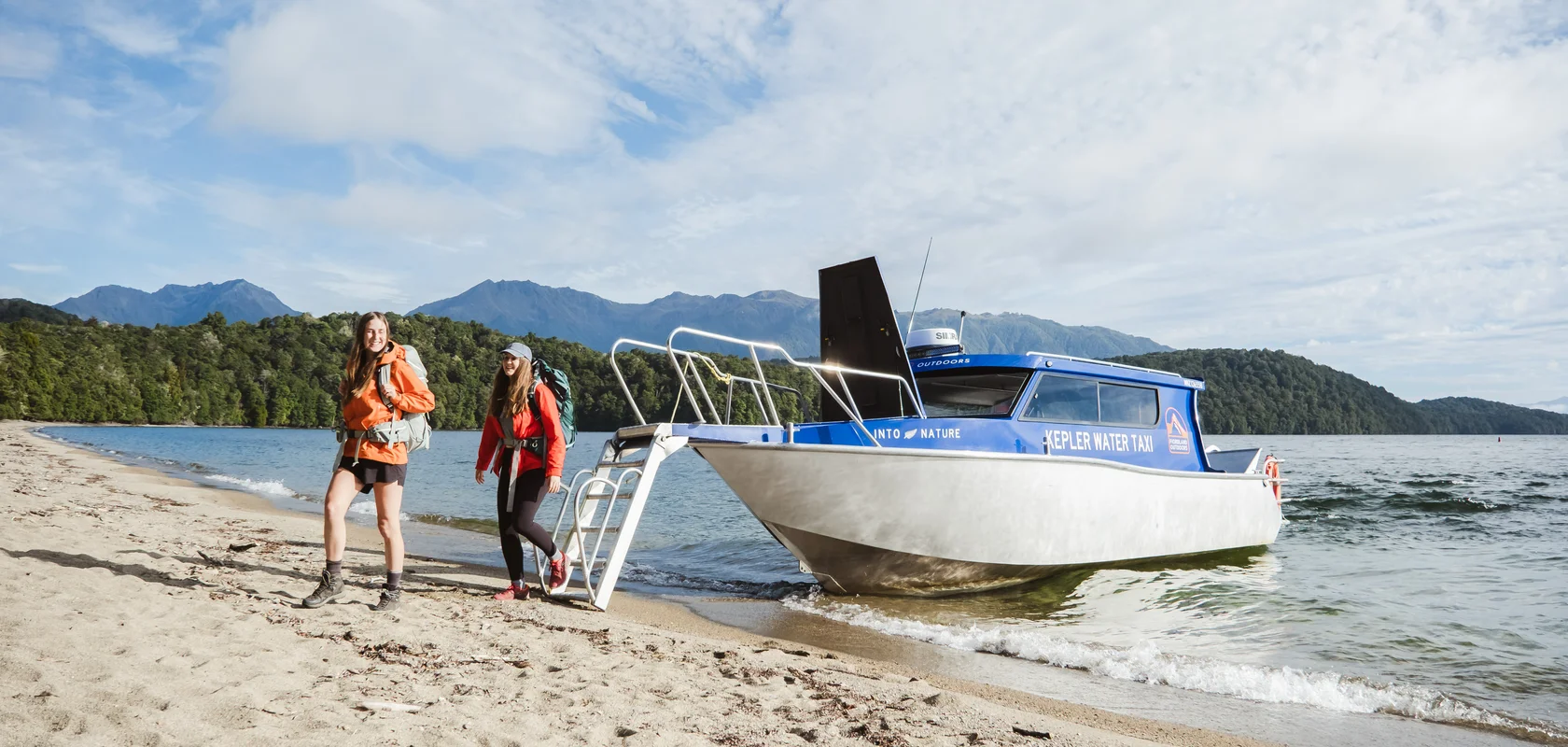
Each track has its own logistics, and getting this right is crucial. The Milford Track, for example, starts at Glade Wharf - which is only accessible by boat across Lake Te Anau. You need a water taxi to get there. It ends at Sandfly Point, from where you take a boat to Milford Sound and then a bus or vehicle back to Te Anau or Queenstown.
The Kepler Track starts and ends near Te Anau township, making it the simplest logistically. The Routeburn Track starts at one end (Routeburn Shelter near Glenorchy) and finishes at the other (The Divide), or vice versa, so you need transport arranged at both ends.
Fiordland Outdoors offers complete transport packages for all three tracks - one booking, everything sorted, no stress. Check our transport options online or get in touch if you want help figuring out the best option for your trip.
Weather & Timing
When is the best time for a beginner to do the Fiordland Great Walks?
The main season runs from late October to late April. Peak summer (December–February) offers the most reliable weather and the longest daylight hours, but it's also the busiest and most competitive for bookings. November and March/April are sweet spots - still good weather, quieter huts, and easier to secure a booking.
All three tracks can be walked in winter, though conditions are more challenging and some tracks require extra alpine experience and gear. The Milford Track operates a winter season with different booking requirements.
Ready to sort your transport? Fiordland Outdoors offers complete, stress-free transport packages for the Milford, Kepler and Routeburn tracks.